
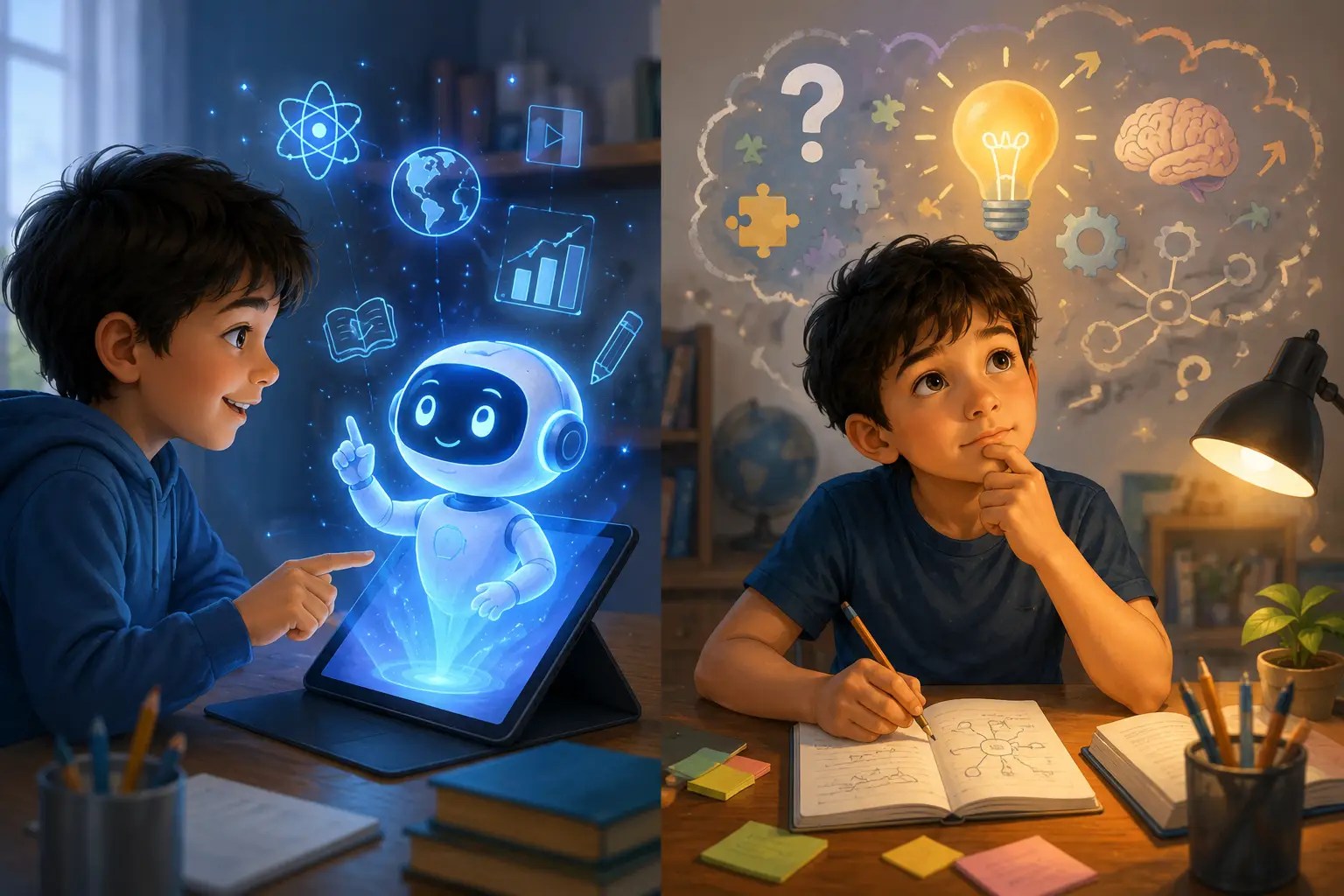
Artificial intelligence is rapidly changing how students learn
A child who is struggling with an assignment can now ask an AI tool to explain a concept, generate ideas, summarize information, organize an argument or help revise a piece of writing.
There is enormous potential here.
For students with learning difficulties, attention challenges or executive functioning weaknesses, technology can reduce barriers that previously made learning unnecessarily difficult. Used thoughtfully, AI may help students access information, receive additional explanation and get started when they are stuck.
But as these tools become increasingly capable, parents and educators face another important question:
What do children still need to learn to do for themselves?
Some of the struggle is part of learning
Learning has never simply been about producing the correct answer.
Consider what happens when a student encounters a difficult assignment. They may need to determine what the question is asking. Decide where to begin. Retrieve relevant information. Organize their thoughts. Try an approach that doesn’t work. Notice the problem. Change strategies. Tolerate frustration. Ask for appropriate help. Evaluate their answer. Revise it.
These processes involve skills psychologists often describe as executive functioning and metacognition. They include planning, organization, working memory, self-monitoring, cognitive flexibility, inhibition and the ability to think about one’s own thinking.
If technology removes every difficult part of a task, we may inadvertently remove some of the opportunities through which these abilities develop.
Sometimes, the friction is the learning.
Support versus substitution
This doesn’t mean children shouldn’t use AI. A more useful distinction may be whether technology is supporting thinking or substituting for thinking.
For example, asking an AI tool to explain fractions in a different way may support learning. Asking it to generate practice questions can support learning. Having a student write an argument and then asking AI to challenge the argument may even deepen critical thinking.
But asking AI to interpret the assignment, formulate the argument, write the response and revise it leaves considerably less thinking for the student to do. The finished product might actually look better. That doesn’t necessarily mean more learning occurred.
The question may be different for different children
The appropriate amount of technological support will not necessarily be the same for every student. A student with a learning disability may legitimately require tools that reduce a particular barrier. A student with significant executive functioning difficulties may benefit from support with organization or task initiation.
The goal isn’t to make learning equally difficult for everyone. It is to identify which skills we are trying to develop, which barriers are preventing the child from demonstrating what they know, and which supports increase access without unnecessarily replacing the cognitive process we want them to practise.
A useful question for adults
As AI becomes increasingly integrated into children’s education, families and schools don’t necessarily need a simple rule of “AI is good” or “AI is bad.” Instead, before introducing an AI support, we can ask: What is the learning goal here? Which part of this task does the child need to practise doing independently? Could AI support the child without doing that part for them?
Technology will continue to evolve. Our understanding of child development still matters.
The goal isn’t to preserve difficulty for its own sake. It is to make sure that in our enthusiasm to give children powerful tools, we continue giving them something equally important: opportunities to discover that they can think, struggle, solve problems and become increasingly capable on their own.
Source: Government of Canada materials regarding the proposed Safe Social Media Act / Bill C-34, including provisions concerning social media services and AI chatbot services (https://www.canada.ca/en/canadian-heritage/services/safe-social-media-act.html)