
Psychological assessments are among the most valuable services a clinician can provide. A well-conducted assessment helps answer important questions about cognitive, emotional, behavioural, and adaptive functioning, allowing individuals, families, schools, and healthcare providers to make informed decisions.
While graduate training provides a strong foundation in assessment theory and standardized testing, applying that knowledge in real clinical settings takes practice. Every client presents with a unique history, different strengths and challenges, and a referral question that requires thoughtful clinical reasoning.
At Rocky Mountain Psychological Services (RMPS), we have been providing comprehensive psychological assessments for children, adolescents, adults, and families for more than 30 years. Through our professional training division, Lighthouse, we also provide formal assessment training and clinical supervision to provisional psychologists and early-career clinicians. Over the years, we have seen that many assessment challenges are common among new clinicians.
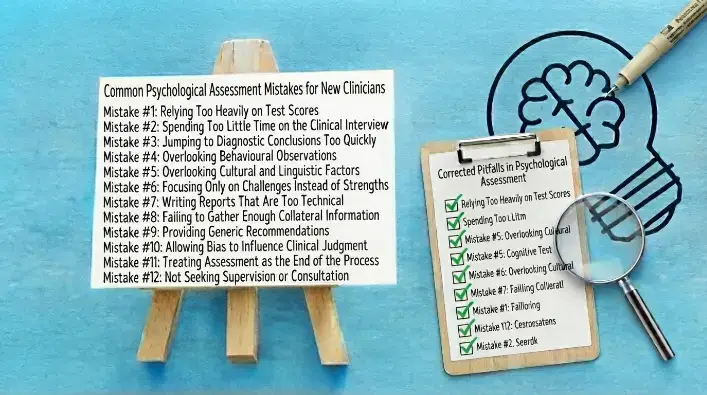
Below are some of the most common mistakes early-career clinicians make during psychological assessments and practical strategies to help avoid them.
Mistake #1: Relying Too Heavily on Test Scores
Standardized assessments are essential tools, but they should never be interpreted in isolation. One of the most common mistakes new clinicians make is assuming that test scores provide definitive answers.
For example, two children may receive similar cognitive scores but have completely different developmental histories and learning needs. One may struggle because of a learning disorder, while another may be experiencing significant anxiety that affects concentration during testing.
Experienced clinicians view test results as one piece of a much larger puzzle. They integrate standardized scores with behavioural observations, interviews, developmental history, and collateral information before reaching diagnostic conclusions (Meyer et al., 2001).
RMPS Tip: Before interpreting a score, ask yourself, “Does this result fit the overall clinical picture?” If it does not, explore alternative explanations rather than relying on the numbers alone.
Mistake #2: Spending Too Little Time on the Clinical Interview
A thorough clinical interview lays the foundation for every psychological assessment. Yet new clinicians sometimes focus so heavily on test administration that they overlook the value of gathering detailed background information.
The clinical interview provides context that standardized tests cannot capture. It helps clinicians understand developmental milestones, family history, educational experiences, medical conditions, social functioning, previous interventions, and the client’s current concerns.
For example, knowing that a child experienced early speech delays, frequent ear infections, or significant family stress may help explain patterns observed during testing. Likewise, understanding an adult’s educational background or occupational history can provide important insight into current cognitive or emotional functioning.
The Standards for Educational and Psychological Testing emphasize that assessment results should always be interpreted within the context of relevant background information (AERA, APA, & NCME, 2014).
RMPS Tip: Think of the clinical interview as the framework that gives meaning to the assessment results. The stronger your interview, the more accurate your interpretation is likely to be.
Mistake #3: Jumping to Diagnostic Conclusions Too Quickly
This tendency, known as confirmation bias, can lead clinicians to focus on information that supports their initial impression while overlooking evidence that points in another direction.
For example, a child referred for an ADHD assessment may also present with anxiety, sleep difficulties, trauma, or a learning disorder. Each of these factors can contribute to problems with attention and concentration. Without considering alternative explanations, clinicians risk making an inaccurate diagnosis.
Good assessment involves remaining curious throughout the evaluation. Rather than asking, “Does this person have ADHD?” ask, “What factors best explain the difficulties this individual is experiencing?”
Keeping multiple diagnostic possibilities in mind improves clinical reasoning and supports more accurate assessments (Mash & Hunsley, 2005).
RMPS Tip: Challenge your first impression. Ask yourself what evidence supports your hypothesis and what evidence may suggest a different explanation.
Mistake #4: Overlooking Behavioural Observations
Behavioural observations are just as important as test scores, yet they are often underutilized by new clinicians.
How a client approaches testing can provide valuable insight into their cognitive and emotional functioning. Observing attention, persistence, frustration tolerance, social interaction, problem-solving strategies, and emotional regulation often helps explain patterns seen in standardized results.
For instance, a child who becomes discouraged after making mistakes may perform below their actual ability because anxiety affects their confidence. Another child may demonstrate strong persistence despite cognitive challenges, revealing important strengths that should be reflected in the final report.
Behavioural observations also help clinicians determine whether assessment results accurately represent an individual’s everyday functioning. They provide context that numbers alone cannot capture and often contribute to stronger diagnostic formulations (Groth-Marnat & Wright, 2016).
RMPS Tip: Record behavioural observations throughout the assessment, not just at the beginning or end. Small details often become valuable pieces of the overall clinical picture.
Mistake #5: Overlooking Cultural and Linguistic Factors
Standardized assessment tools are developed using specific normative samples, and although many have strong psychometric properties, they may not fully reflect the experiences of every individual. Language proficiency, cultural values, educational opportunities, socioeconomic circumstances, and previous exposure to testing can all influence assessment performance.
For example, a child who recently immigrated to Canada may perform differently on language-based tasks than a child whose first language is English. Similarly, cultural norms around communication, eye contact, or emotional expression should not be mistaken for psychological concerns without careful consideration.
Culturally responsive assessment requires clinicians to understand the client’s background, recognize the limitations of assessment tools, and interpret findings within the appropriate context (American Psychological Association, 2017).
RMPS Tip: When assessment findings and a client’s history do not align, consider whether cultural or linguistic factors may be influencing performance before reaching diagnostic conclusions.
Mistake #6: Focusing Only on Challenges Instead of Strengths
New clinicians sometimes produce reports that focus heavily on deficits while giving little attention to abilities, interests, or protective factors. This can leave clients and families feeling discouraged and may limit opportunities for strengths-based intervention.
Every assessment should answer two important questions:
- What areas require support?
- What strengths can be used to support success?
Strengths may include strong verbal reasoning, creativity, perseverance, social skills, family support, adaptive coping strategies, or personal interests. Recognizing these strengths helps create balanced recommendations that encourage growth rather than focusing solely on limitations.
Research in positive psychology suggests that building on individual strengths can improve resilience, motivation, and overall well-being (Seligman, 2011).
RMPS Tip: Before finalizing your report, review whether every identified challenge is balanced with a meaningful strength whenever appropriate.
Mistake #7: Writing Reports That Are Too Technical
A psychological assessment report should communicate complex clinical information in a way that is understandable to everyone who reads it.
For example, instead of writing:
“The client demonstrated deficits in executive functioning characterized by impaired cognitive flexibility.”
You could write:
“The assessment suggests the client may have difficulty adjusting to changes, switching between tasks, and organizing complex activities, which may affect school, work, or daily routines.”
The second example is equally accurate but much easier for non-psychologists to understand.
Clear communication is an essential clinical skill. Reports should explain not only what the assessment found, but also how those findings affect everyday functioning and why the recommendations are appropriate.
RMPS Tip: Imagine a parent reading your report for the first time. If they cannot easily understand your conclusions, consider simplifying the language without compromising clinical accuracy.
Mistake #8: Failing to Gather Enough Collateral Information
Clients often behave differently across settings, which is why collateral information plays such an important role in psychological assessment. For example, a child may appear calm and attentive during one-on-one testing but experience significant attention or behavioural challenges in a busy classroom. Useful collateral information may include:
- Parent or caregiver interviews
- Teacher questionnaires
- School records
- Medical records
- Previous psychological assessments
- Speech-language or occupational therapy reports
When information from multiple sources points toward the same conclusion, clinicians can be more confident in their diagnostic formulation. When different sources provide conflicting information, those differences often become important clinical findings that deserve further exploration rather than being ignored (Mash & Hunsley, 2005).
RMPS Tip: If your conclusions rely on only one source of information, ask yourself whether additional collateral information could strengthen the assessment.
Mistake #9: Providing Generic Recommendations
Recommendations such as “continue therapy,” “provide classroom accommodations,” or “monitor symptoms” are too broad to guide meaningful action. Effective recommendations should be specific, practical, and tailored to the individual’s needs.
For example, instead of recommending “executive functioning support,” consider suggesting strategies such as:
- Break large assignments into smaller, manageable tasks.
- Provide written instructions alongside verbal directions.
- Use visual schedules or organizational checklists.
- Schedule regular teacher or supervisor check-ins.
Recommendations should also reflect the client’s age, environment, available resources, and goals. Practical guidance is far more likely to be implemented than vague suggestions.
RMPS Tip: Ask yourself whether someone reading your report could immediately act on your recommendations. If not, make them more specific.
Mistake #10: Allowing Bias to Influence Clinical Judgment
Every clinician brings personal experiences, assumptions, and expectations into the assessment process. While these experiences can be valuable, they can also influence clinical judgment if left unchecked.
Common cognitive biases include:
- Confirmation bias: Looking for evidence that supports an initial impression while overlooking contradictory information.
- Anchoring bias: Relying too heavily on the referral question or first observation.
- Availability bias: Giving greater weight to diagnoses or cases that have been seen recently.
Being aware of these biases helps clinicians make more balanced decisions. Throughout the assessment, it is helpful to ask:
- What evidence supports my conclusions?
- What evidence challenges them?
- Have I considered other possible explanations?
Reflective practice is an important part of professional development and contributes to more accurate clinical decision-making (Groth-Marnat & Wright, 2016).
RMPS Tip: If a case seems straightforward, challenge yourself to identify at least one alternative explanation before finalizing your conclusions.
Mistake #11: Treating Assessment as the End of the Process
A psychological assessment should not be viewed as the final step in a client’s journey. Instead, it should serve as a foundation for future support and intervention.
Assessment findings help answer important questions, but they also guide treatment planning, educational supports, workplace accommodations, and future monitoring. Children continue to develop, mental health symptoms can change over time, and interventions often improve functioning.
In some cases, follow-up assessments may be appropriate to evaluate progress, update diagnoses, or revise recommendations based on changing needs.
Helping clients and families understand that assessment is part of an ongoing process encourages realistic expectations and supports long-term success.
RMPS Tip: End your reports by outlining realistic next steps so clients understand how the assessment can guide future planning and intervention.
Mistake #12: Not Seeking Supervision or Consultation
Perhaps the most significant mistake new clinicians make is believing they need to have all the answers.
Psychological assessment is a complex area of practice that develops through experience, mentorship, and continuous learning. Even experienced psychologists regularly consult with colleagues when working with diagnostically complex cases.
Supervision provides opportunities to:
- Strengthen clinical reasoning.
- Improve differential diagnosis.
- Refine report writing.
- Discuss ethical considerations.
- Receive constructive feedback.
- Build confidence in decision-making.
Research has shown that high-quality clinical supervision improves practitioner competence and supports better client outcomes (Milne, 2009).
RMPS Tip: Seeking consultation is not a sign of inexperience. It is a hallmark of ethical, reflective clinical practice.
Best Practices for New Assessment Clinicians
While every assessment is unique, several habits consistently improve both clinical confidence and assessment quality.
- Begin with a thorough clinical interview.
- Select assessment tools that answer the referral question.
- Integrate test scores with behavioural observations and developmental history.
- Gather collateral information whenever possible.
- Consider cultural and linguistic factors throughout the assessment.
- Recognize both strengths and areas requiring support.
- Write reports in language that clients and other professionals can easily understand.
- Develop practical, individualized recommendations.
- Remain open to alternative diagnostic explanations.
- Seek supervision and continue learning throughout your career.
Developing these habits early helps clinicians build a strong foundation for ethical and evidence-informed assessment practice.
Final Thoughts
Conducting psychological assessments is about much more than administering tests or assigning diagnoses. It requires careful listening, critical thinking, sound clinical judgment, and the ability to integrate information from multiple sources into a meaningful understanding of the individual.
At RMPS, we believe that high-quality assessments combine scientific evidence with compassionate, client-centred care. Whether we are supporting individuals and families directly or mentoring the next generation of psychologists through Lighthouse, our goal remains the same: helping clinicians deliver assessments that lead to informed decisions, effective interventions, and better outcomes for the people they serve.
References
American Educational Research Association, American Psychological Association, & National Council on Measurement in Education. (2014). Standards for educational and psychological testing. American Educational Research Association.
American Psychological Association. (2017). Multicultural guidelines: An ecological approach to context, identity, and intersectionality. https://www.apa.org/about/policy/multicultural-guidelines
Groth-Marnat, G., & Wright, A. J. (2016). Handbook of psychological assessment (6th ed.). Wiley.
Mash, E. J., & Hunsley, J. (2005). Developing guidelines for the evidence-based assessment of child and adolescent disorders. Journal of Clinical Child and Adolescent Psychology, 34(3), 362-379. https://doi.org/10.1207/s15374424jccp3403_3
Meyer, G. J., Finn, S. E., Eyde, L. D., Kay, G. G., Moreland, K. L., Dies, R. R., Eisman, E. J., Kubiszyn, T. W., & Reed, G. M. (2001). Psychological testing and psychological assessment: A review of evidence and issues. American Psychologist, 56(2), 128-165. https://doi.org/10.1037/0003-066X.56.2.128
Milne, D. (2009). Evidence-based clinical supervision: Principles and practice. Wiley-Blackwell.
Seligman, M. E. P. (2011). Flourish: A visionary new understanding of happiness and well-being. Free Press.